Last month, I took part in a field trip under the auspices of Yad Ben Zvi, to Second Temple era archaeological sites in the Galilee and the Golan Heights. Since then, tensions on Israel’s northern border (with Lebanon and Syria) have escalated considerably. I doubt if this trip would have been possible now – certainly not the visit to Gamla, in the Golan Heights.
The tour guide who was supposed to accompany us on this trip, Eran (who also led our last trip, to Yodfat and Migdal/Magdala) was unavailable this time, having been recalled to military reserve duty. Instead, we had Dafna, who proved equally knowledgeable and inspiring.
The weather was less promising this trip. The weather forecast predicted rain in the afternoon – and indeed, when we reached our first stop, Tiberias, the skies were cloudy and overcast and the Kinneret (Sea of Galilee) looked sullen and grey.

Tiberias was the most important Jewish city in the Land of Israel for several centuries following the destruction of the Temple in Jerusalem. Founded by Herod Antipas, son of Herod the Great, it was named in honour of the Roman Emperor Tiberius. For about 200 years, from the early 3rd century CE to the early 5th century CE, it was the site of the Sanhedrin till that institution was disbanded in 425 CE.
Tiberias was the seat of Herod Antipas’s palace as well as a huge theatre, which could seat 7000 spectators. It was this theatre which we had come to see.
Unfortunately, for many years, the archaeological sites in Tiberias have been neglected, victims of jurisdiction disputes between local and national authorities, as well as the contentious internal politics within Tiberias. This neglect was evident in the narrow, winding, overgrown path we took leading up to the ruins of the great theatre.

In many places, we had to battle our way through dense vegetation, some of it – well, rather spiky!


This last plant is called kipodan (קיפודן) in Hebrew, or, to give it its scientific name – Echinops. The Hebrew name shares a common root with the word for hedgehog – kipod (קיפוד) – for obvious reasons.
I learned its name after another member of the group showed me how to do a Google search by image on my mobile phone. I am so behind on modern technology 😉 .
The great theatre of Tiberias, built in the 1st century CE on the slopes of Mt. Bereniki and overlooking the Sea of Galilee, seated, as I said earlier, some 7000 spectators and had a huge stage.
Today, it is overgrown with grass and wildflowers and appears quite small.

If you look closely, however, you can see the walls which indicate a second tier of seats and even a third:

As I have said on more than one occasion, you often need to use a great deal of imagination to picture archaeological remains in their glory days – especially when, as in this case, squabbling between the local and national authorities have led to the shameful neglect of what has the potential to rival Caesarea as a heritage site.
I mentioned that the theatre was built on the slopes of Mount Bereniki. Bereniki was a princess of the Herodian dynasty, who was the lover of Titus (son of the Emperor Vespasian and later, emperor himself). Titus was the man responsible for conquering Jerusalem in the Great Revolt, and burning down the Temple. As you can imagine, Bereniki’s relationship with him was unpopular, to say the least, among her own people – as well as among the Romans, who always looked askance on what they perceived to be lascivious Oriental seductresses (Cleopatra is another example). Bereniki lived openly for a time with Titus in Rome, and he is said to have promised to marry her, but when he eventually became emperor and was advised that their scandalous relationship would be severely detrimental to his popularity and standing among the Roman people, he decided that power trumps love and sent her away.
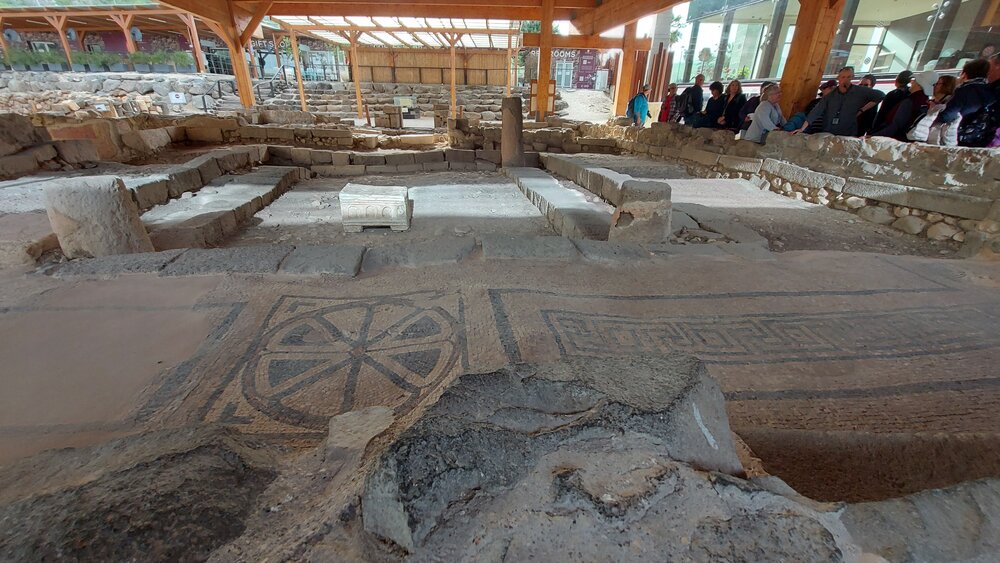
It was raining quite heavily by the time we reached our next port of call, Kfar Nahum (Capernaum), which my Christian readers will recognise as being one of the villages around the Sea of Galilee where Jesus is supposed to have preached. The site is owned and administered by the Franciscan Order, the official Custodians of the Holy Places on behalf of the Roman Catholic Church. Archaeological investigations have revealed that the village was apparently founded in the 2nd century BCE, during the Hasmonean period. The synagogue which is a popular destination for visiting Christian tour groups, is not the one where Jesus preached, as it dates to the 4th century CE, although it was constructed atop an older building.


Interestingly, the synagogue – which faces Jerusalem – was built of white limestone, whereas the dwellings excavated nearby were of coarser, black basalt.

The latter was much cheaper, of course, being a local stone, whereas the more expensive limestone was brought from more distant quarries. So – who built the synagogue? And for whom? Kfar Nahum is the only place where a large synagogue has been found next to a church from the same period. The church (about which, more later) and the synagogue both date to the Byzantine period – a time when relations between Jews and Christians in the Land of Israel were exceedingly tense. It has been suggested that, by the time the “synagogue” was built, Kfar Nahum was a Christian town and that local tourism entrepreneurs wanted to show Christian pilgrims the synagogue where Jesus preached and which he cursed. Since there was no longer any synagogue – or the one which had existed was in ruins – they built a new one, or transferred one from elsewhere. (Beneath the ruins of the white limestone synagogue, remains have been found of an earlier building, constructed of the more usual black basalt – more in line with the economic capabilities of a small fishing village.) Indeed, the archaeological finds around this site were rather eclectic, suggesting elements were imported from other places. Many of these are displayed around the courtyard in front of the ticket office.

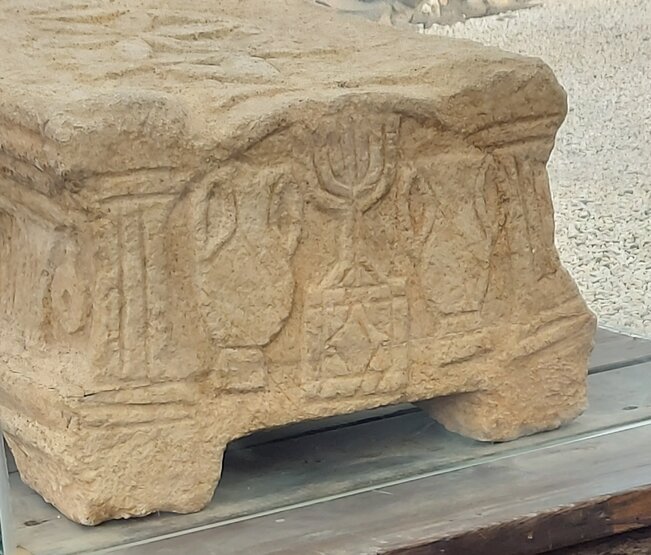
In the image below, you might see what is nowadays known as the quintessentially Jewish Star or Shield of David. However, it only became recognised as a specifically Jewish symbol in the Middle Ages – centuries after these beautiful decorations were carved.


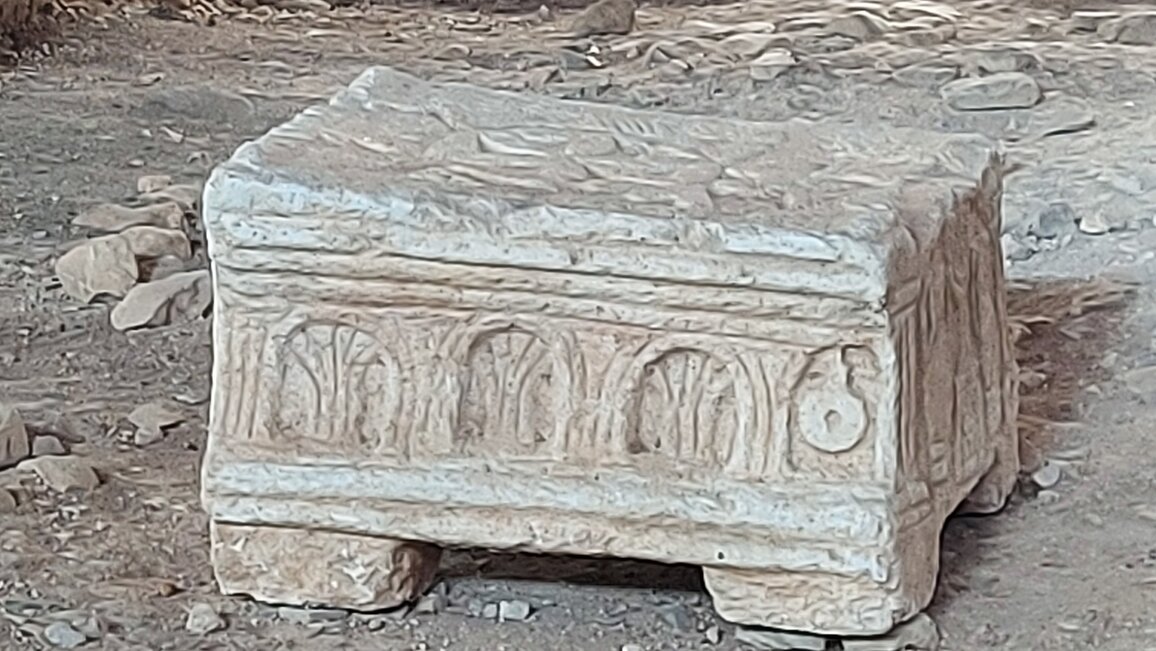
According to the sign adjacent to the artefact below, the carving represents either the Ark of the Covenant or “a carriage that was used to transport and house the large, handwritten scrolls of the Jewish Torah … of which every synagogue had a copy”.
Well – possibly.


Another point of interest – especially to my Christian readers – is the so-called “House of Peter”.
Today, a modern church (dedicated in 1990) stands over the ruins of an octagonal Byzantine church, dating to the 5th century CE. A glass window in the floor of the modern church permits the visitor to look down on the remains of the Byzantine church:

And here is a closer look at the remains:


This is another of those places where you have to see things with the Mind’s Eye. Perhaps the view through the observation window in the floor of the modern church (which is built on stilts) will help. The Byzantine church was itself constructed over a private dwelling dating to the 1st-century CE (ie. the Second Temple period). Excavation of the earlier building revealed that the walls and floor of one of the rooms had been covered with plaster and that frescos had adorned the walls. Plaster fragments, bearing inscriptions, mostly in Greek, such as “the Nazarene”, “Our Lord”, etc. suggest that the house served as a place of worship for one of the earliest Christian communities – a domus ecclesia, or House of Assembly. These were private homes where the Christian community used to gather, before the establishment of churches. Excavators on behalf of the Franciscan Order concluded that, as early as the middle of the 1st century CE, the house was venerated as the home of the apostle Peter.
By now, we were all getting very hungry. The rain had stopped, so we paused for a quick picnic lunch at Park Hayarden – the Jordan River Park.

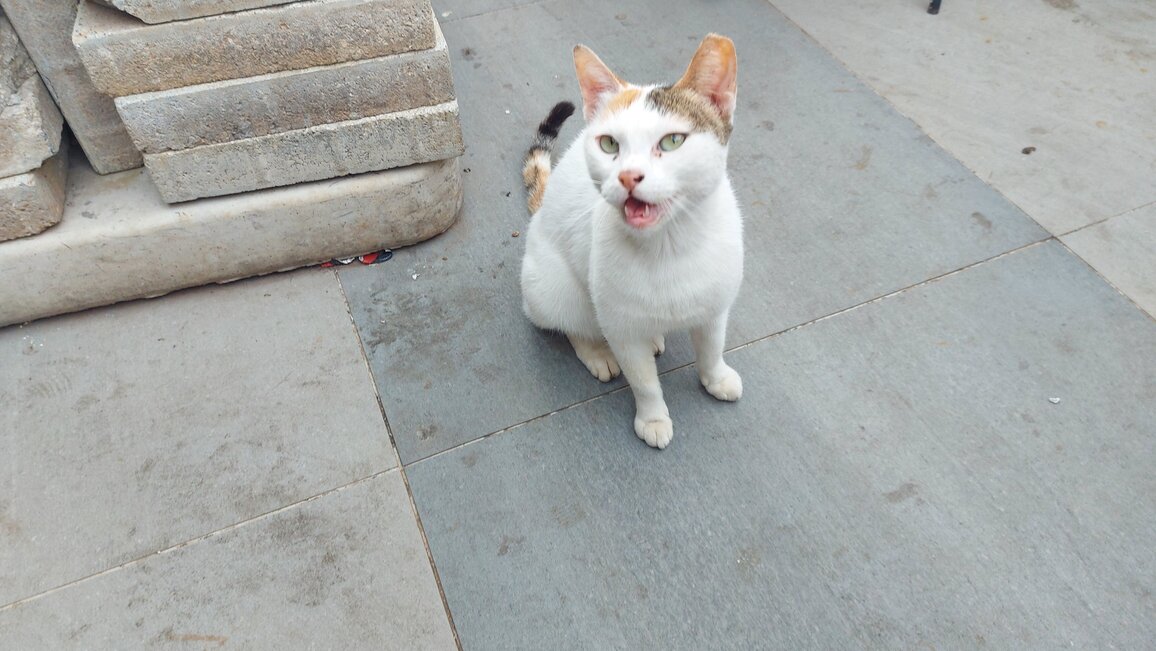
Naturally, I used my time there to make friends with a representative of the local feline population:

It was already past 3 pm and we still had two places to visit. First up was Beit Saida – which may, or may not be, the Bethsaida mentioned in the New Testament. The archaeological site which was first suggested by the American scholar Edward Robinson in the 19th century and which lies within the Jordan River Park, is rather too far from the Kinneret (Sea of Galilee) to have been a fishing village.


It has been suggested that the topography has changed since the Second Temple era – that the site has been raised by an earthquake and/or that the Kinneret has shrunk in size, so that a town which in the 1st century CE lay on the shore of the lake, now lies several kilometres inland. However, Dafna, our tour-guide, told us that buildings dating to that period have been unearthed on land which, in that case, should have been beneath the surface of the lake in Jesus’ time – so this theory doesn’t hold water (pardon the pun).
At all events, excavations here have unearthed remains of a Hellenistic city, and beneath that, even older remains, from the Iron Age (First Temple period). Some scholars believe these earlier remains to be those of the city-state of Geshur. One of King David’s wives, Maacah the mother of Absalom, was the daughter of the King of Geshur. In addition, there is an even older layer, dating back to the Bronze Age.
The remains from the Iron Age included a defensive wall with a large gate and two towers, and two chambers on either side.

The courtyard in front of the gates of cities at this time would have served for public business. Here, the city elders would have sat in judgement, here the money-changers would have set up shop, here would have been places of worship.
Next to the gate, which was burned round about the time of the Assyrian invasion in the mid-8th century BCE, there were three sacrificial platforms, and seven small basalt columns, one of which we see here. It is decorated with a bull’s head.

I know, I know. It’s hard to see. You may just have to take my word for it 😉 .
We still had one more site to visit and it was getting late. Although we had put the clocks forward a week and a half previously, we had less than a couple of hours to go till sunset – and the Gamla site closes at 5 pm. So it was back to the buses for the climb up into the Golan Heights, with their stunning views.


Due to the constraints of time, we did not take the winding road down into the Gamla archaeological site, but instead, headed for the Vulture Lookout. The Gamla Nature Reserve is famous as a nesting site for Griffon Vultures. From the carpark, we headed up the Vulture Trail (wheelchair-accessible, by the way) to one of the lookout points overlooking the camel-humped shaped ridge which gave the ancient city its name (Gamal – גמל – means camel in Hebrew). I am not certain that the magnificent winged specimen I photographed was, in fact, a vulture:

But, in any case, it was not the vultures (an endangered species) we had come to see, but the ruins of Gamla, which had been fortified in 66 CE by our old friend, Yosef ben Matityahu aka Josephus, in his role as the Jewish Commander of the Galilee and Golan Region during the Great Revolt. Gamla was one of only five cities in the region to join the Revolt.
Once a Seleucid fort, it had been conquered by the Hasmoneans, who turned it into a city. Archaeologists uncovered a typical Jewish city, with ritual baths and a synagogue (see image below), one of the world’s oldest, dating – it is believed – back to the 1st century BCE. They also discovered thousands of Hasmonean coins – as well as 7 coins minted in Gamla at the time of the uprising, with the Hebrew words for “Deliverance” on one side and “Holy Jerusalem” on the other.

Built of dressed stone, the synagogue had a main hall measuring 22 by 17 metres, and was characterised by pillared aisles and a surrounding Doric colonnade. It also had a ritual bath (mikveh) adjacent to its entrance.
Surrounded by steep ravines, Gamla must have appeared well-nigh impregnable and it is no wonder that Josephus made it his principal fortress in the Golan.

The city was besieged by the Romans for months before the final assault (they didn’t have a Biden or a Blinken constantly looking over their shoulder, going on and on about “humanitarian aid” or the need to protect “innocent non-combatants”). Excavations have unearthed thousands of Roman weapons – arrowheads, ballista stones and catapult bolts. Josephus records, in The Jewish War, that some 4,000 inhabitants were slaughtered, while 5,000, trying to escape down the steep northern slope, were either trampled to death, fell or perhaps threw themselves down a ravine.
Here we can see one of the breaches in the defensive wall. According to our tour-guide, Dafna, the tower surmounting the wall had faulty foundations and when the Romans breached the lower reaches, the entire tower collapsed:

After the town’s destruction by the Romans, Gamla was abandoned, never to be rebuilt – unlike other towns. Unlike Jerusalem.
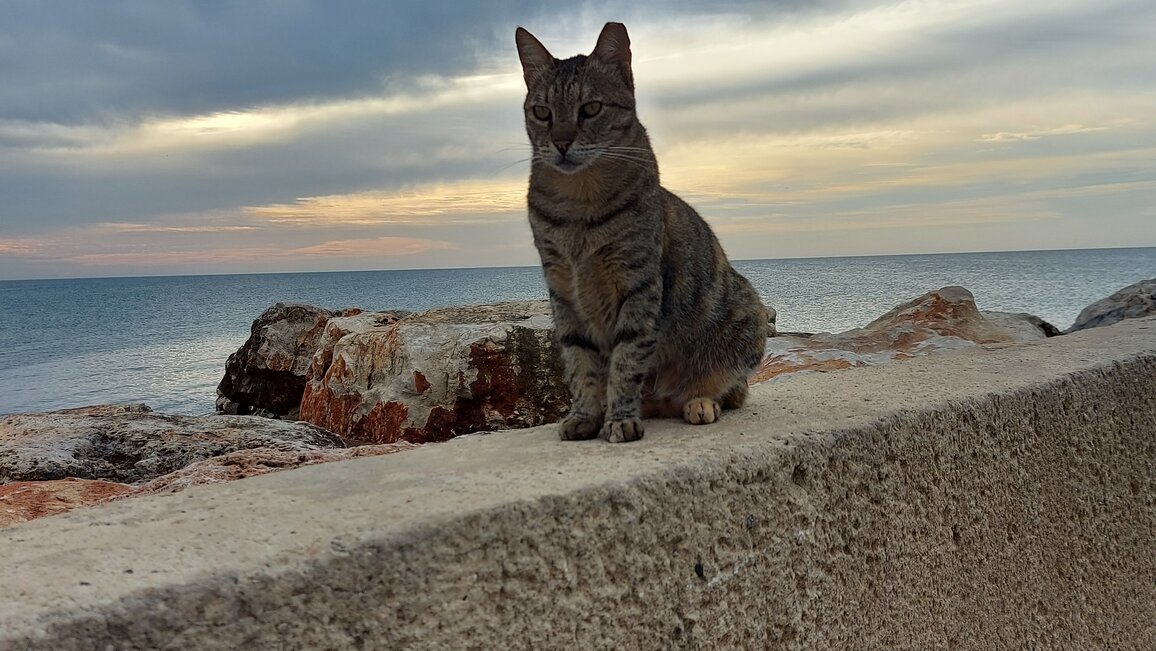
The site was about to close and we had to think about heading home. Stopping on the way for a bathroom break, I met yet another little feline, who made friendly overtures:

And then it was straight back to Jerusalem – not before a beautiful sunset signalled the end of a beautiful day:
































 THE VIEW FROM THE PALACE